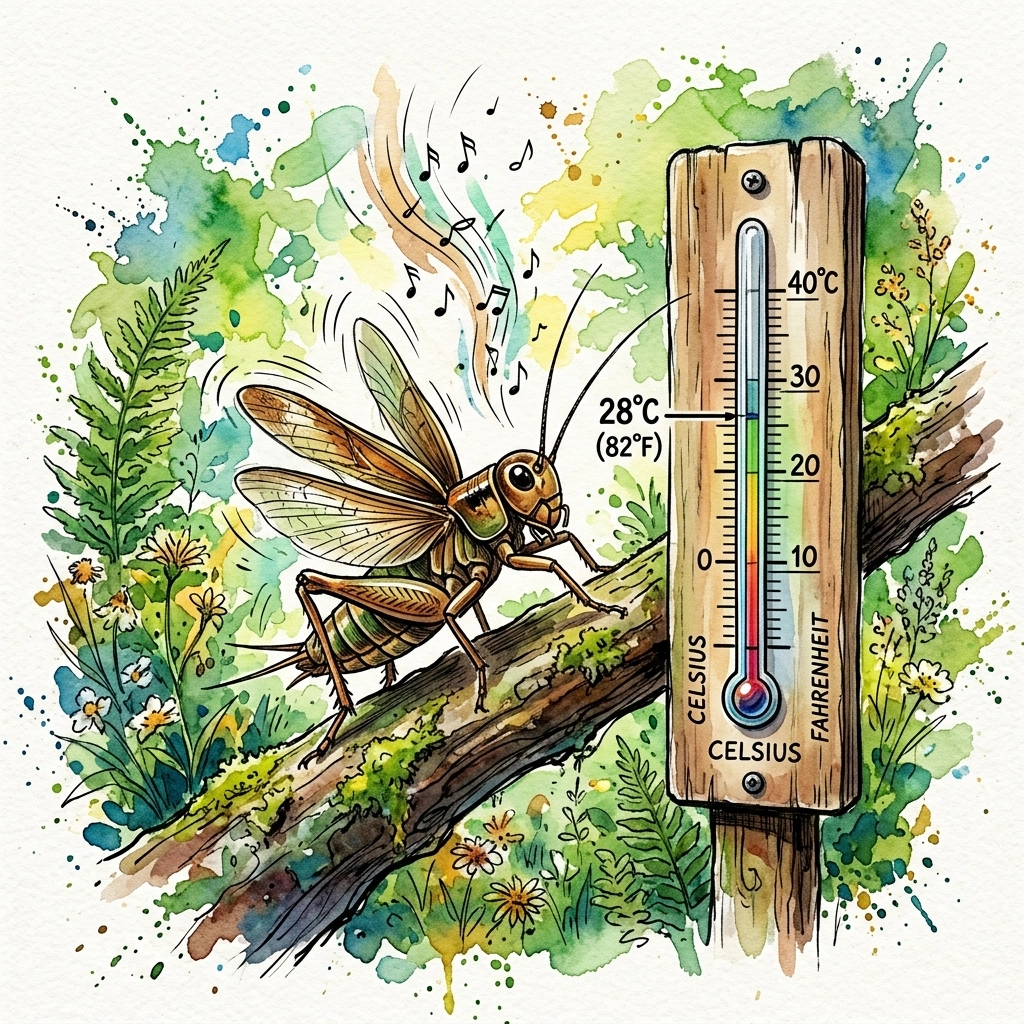
# Complete Guide: How to Use Dolbear's Law to Calculate Temperature
Did you know you can tell the exact temperature just by listening to nature? In 1897, physicist Amos Dolbear discovered a precise mathematical relationship between the rate of cricket chirps and the ambient heat. This tool digitalizes that discovery to turn your phone into a natural thermometer.Why do crickets sing?
The cricket's "song", or stridulation, is actually a mating call. Males rub their wings (not their legs) together to create this sound. Fascinatingly, since they are cold-blooded animals (ectotherms), the speed of this rubbing depends directly on the thermal energy of the air.
# The Science: Ectothermy and Metabolism
Unlike mammals, which maintain a constant body temperature, insects depend on external heat. Their biochemical reactions follow the Arrhenius Equation: the more heat, the faster the reaction.This means that for the cricket's muscles to contract and rub its wings, they need enzymatic reactions. If it's cold, these reactions are slow and the chirp is sluggish. If it's warm, metabolism speeds up and the song becomes a frantic trill.# Dolbear's Formula
Although variations exist for different species, the most famous formula is for the snow tree cricket (Oecanthus fultoni). To obtain the temperature in degrees Celsius:Our tool does this automatically: it measures the time between your taps, calculates chirps per minute (BPM) and applies the formula instantly.T(°C) = 10 + (N - 40) / 7Where N = number of chirps per minute.
# Fascinating Facts
- Thermometers of Love: Some theories suggest that females prefer males who sing at the "correct" frequency for the current temperature, as it indicates the male is healthy and has a strong metabolism.
- Cold Limit: Below 10°C (50°F), most crickets stop singing because their metabolism is too slow to sustain the muscular effort.
- Synchronization: On warm nights, thousands of crickets can synchronize their chirps, creating an impressive "wave" sound effect.
Accuracy Note
Accuracy depends on the cricket species. This tool is calibrated for the common field cricket and tree cricket. Factors such as humidity or wind can alter the result by ±0.5°C.